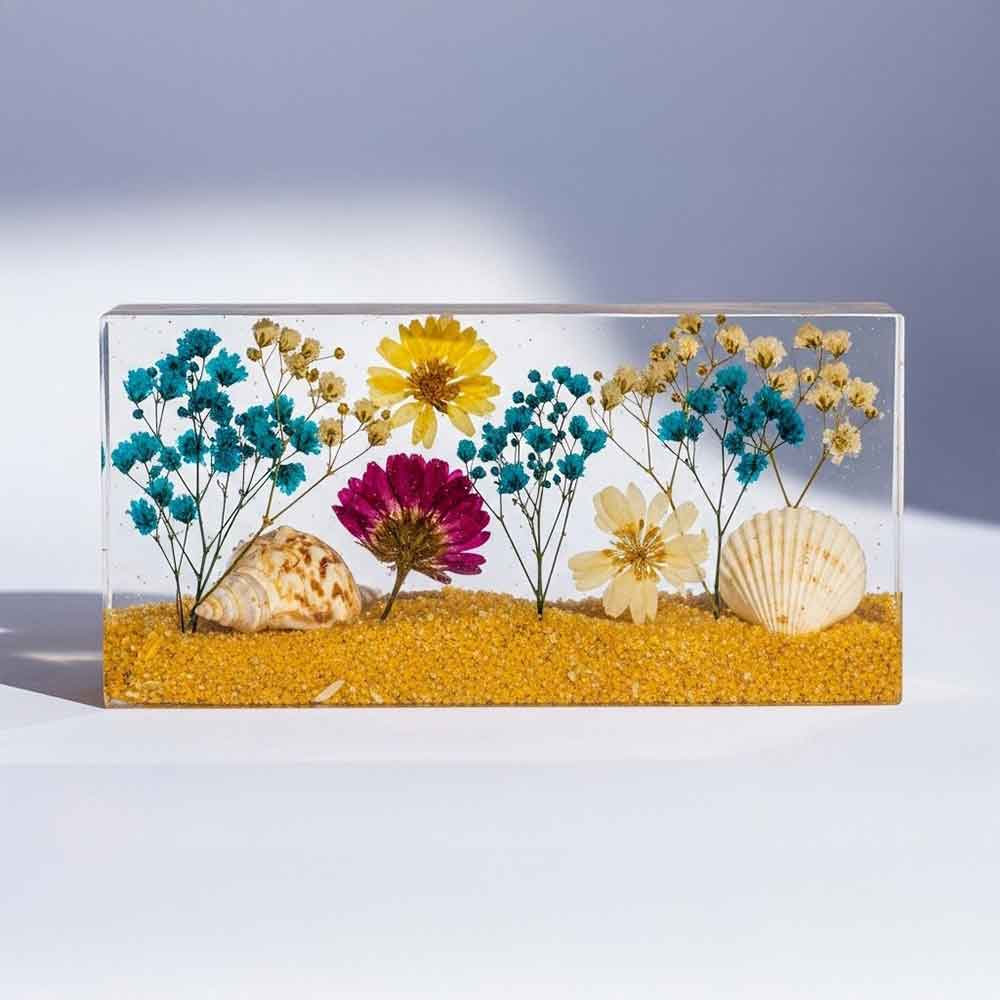
Epoxy resin can be used in many fields, ranging from the creation of decorative objects and jewelry to furniture customization and floor coatings. Its properties make this type of resin a highly sought-after material. Completely waterproof, it is also widely used in the marine industry. Resistant to almost all chemical agents, epoxy resin nevertheless has one weak point: sunlight. When exposed to UV rays, it can yellow and lose some of its transparency. To protect it from this phenomenon, epoxy resin can be colored using different methods. In addition to enhancing its appearance, color also acts as UV protection. Here’s how to color your epoxy resin.
Which colorants should be used for epoxy resin?
To color epoxy resin, it is important to use suitable products. There are several types of colorants you can use.
Natural and synthetic pigments
Pigments provide very attractive results when used with epoxy resin. Supplied in powder form, there are two types: natural pigments and synthetic pigments. Natural pigments are derived from minerals but are becoming increasingly rare on the market. As an alternative, synthetic pigments are an excellent solution. They are available in a wide range of colors and finishes to suit all needs. There are even luminous pigments that glow in the dark.
Specialized paint
If you do not wish to use pigments, paint can also be used to color epoxy resin. However, not just any paint will do. For optimal results, it is essential to choose a liquid epoxy paint. Easy to mix, it provides a uniform and consistent aesthetic finish.
Good to know: Apart from the products mentioned above, it is not recommended to use other types of colorants to tint epoxy resin. Oil paints, latex paints, or even nail polish are not suitable and do not produce satisfactory results.
How to color epoxy resin
Would you like to start coloring epoxy resin but are not sure where to begin? Follow the guide!
Preparing the resin
First, you need to prepare the epoxy resin. This step must be carried out carefully to achieve a high-quality final result. Mix the two epoxy components (the resin and the hardener) until you obtain a homogeneous mixture. Be sure to carefully follow the manufacturer’s instructions.
Adding color to the resin
Before adding pigment or paint to the epoxy resin, it is important to note that the proportion of colorant should not exceed 0.2% to 0.5% by weight for pigments. For liquid colorants, add them drop by drop and always perform preliminary tests. It is recommended to start with a very small amount of colorant, assess the color, and gradually add more until the desired intensity is achieved. If you use powdered pigment, adding too much can prevent proper dispersion and result in a grainy mixture. Mix thoroughly until the color is uniform and eliminate as many air bubbles as possible.
Casting the resin
Once you have achieved the desired color, simply pour the mixture into a silicone mold or onto the surface to be coated. At this stage, you are free to add inclusions such as glitter or dried petals. Then allow the resin to cure in open air for the required time.
Good to know: All stages of epoxy resin preparation and coloring must be carried out while wearing appropriate safety equipment. For your health and safety, always use protective goggles, a respirator mask, and nitrile gloves before handling these products.