The polymerization reaction of epoxy resin is exothermic, meaning it releases heat. This heat is significant, as the most reactive systems can reach temperatures above 200 °C. If the temperature rise is too high, deformation or yellowing of the part may occur. To ensure an optimal result, it is necessary to select the hardener reactivity according to the size of your project.
Exothermic behavior depends on several factors:
The most important factor is the mass of the pour. The larger the mixed quantity, the faster the polymerization reaction and the more intense the temperature increase. If a large amount of mixture remains, divide it into several containers to limit the rise in temperature.
No, always use the resin and the hardener from the same system only. Our formulations are designed to be mixed together. If you do not use matching systems, you risk ruining both your mixture and your project.
A casting epoxy resin is a resin formulated to be poured in thick layers, offering excellent transparency, low exothermic reaction, and uniform curing. It is ideal for river tables, decorative objects, inclusions, and mold casting.
It depends on the resin formulation. Some are designed for thin pours, while others allow thick pours reaching several centimeters per layer. It is essential to always follow the manufacturer’s recommendations.
At Sicomin, we offer two systems suited to all types of projects:
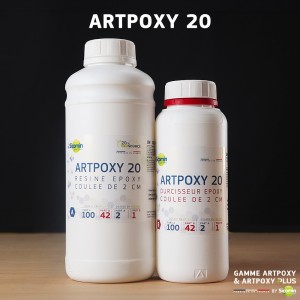
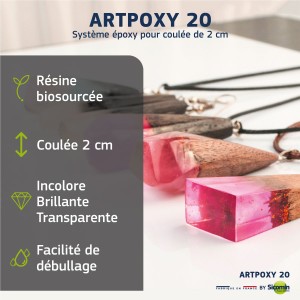
ARTPOXY 20 & ARTPOXY 20 PLUS: ideal for creating decorative objects and thin pours, up to 2 cm thick.
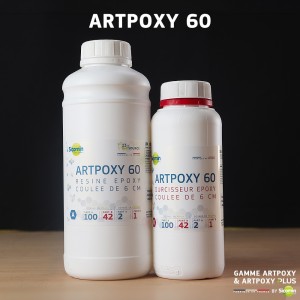
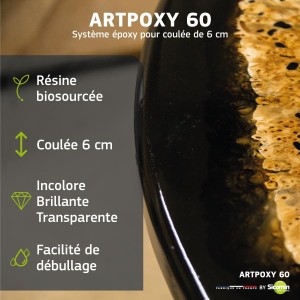
ARTPOXY 60 & ARTPOXY 60 PLUS: specially designed for river tables and thick pours, up to 6 cm thick.
Yes, if the resin is designed for mass casting. Otherwise, it is preferable to work in several layers to avoid overheating, bubbles, or cracking.
If you are unsure about choosing the system best suited to your project, do not hesitate to contact us so that we can provide the best solution for your needs.
The curing time of a casting epoxy resin depends on several factors: the resin formulation, the pour thickness, and the ambient temperature.
In general, epoxy resin is dry to the touch after 24 to 48 hours, but full curing requires several days.
For our casting systems:
ARTPOXY 20 (thin pours up to 2 cm) allows demolding after approximately 24 hours at 20 °C.
ARTPOXY 60 (thick pours up to 6 cm) requires a demolding time of about 4 days at 20 °C, due to its formulation designed for large thicknesses.
To ensure optimal performance, it is essential to respect the recommended maximum thicknesses and the application conditions specified by the manufacturer.
Epoxy resin can withstand moderate heat, but it is not designed to resist high temperatures or prolonged direct contact with heat sources.
It is therefore strongly recommended to place an insulating support between the epoxy resin and any heat source. For example, with river tables, using a trivet is essential to avoid placing hot kitchen utensils such as pans or pots directly on the resin surface. This helps preserve the appearance and long-term durability of the resin.
 Guides & Tips
 Your achievements