
NAUTISM : Use of resins in marine environment
The main epoxy resins for the nautical industry.
The choice of an epoxy resin for use in the marine environment will depend on the task to be performed, whether in the field of manufacturing or repair:
For traditional contact lamination (fiber and resin) the SR 8500 system and its range of SD 860x hardeners (8601 for the slower and 8605 plus the more reactive, with the possibility, for example, of mixing the two at 50/50 to obtain an intermediate hardener).
This standard system is also compatible with vacuum lamination as in repair.
(note: it is sometimes useful to incorporate 2 to 10% of filler, such as silicell or other, to obtain a "gel" appearance resin before laying the first fiber ply: this allows to obtain a better clinging of the fabrics on the support, to avoid that the resin runs when the temperature is important and that the viscosity of the resin is low: important temperature = resin + fluid).
The SR 5550 system associated with SD 550x has been specially developed for laminating on wood. Its simplified 3:1 ratio is highly appreciated by users.
The SR 8450 /SD 845x system has been designed for tropicalized environments with high humidity (wood or fiberglass lamination). (wood or fiber laminate).
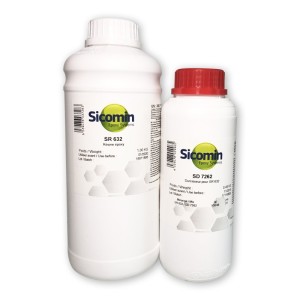
SR 632 / SD 7262 is a fast curing resin that is capable of immersion curing. (Emergency but permanent repair).
Infusion manufacturing is done mainly with our most used system SR 8100 / SD 882x
infusion of a 9.40 m hull in SR8100/SD 8222
Repairs or fabrication requiring high mechanical stress, such as mast repair, can be done with the high modulus system SR1700 / 270x.
Bonding of bulkheads on hull or deck can be done with the ISOBOND SR 1170 / SD 407x range.
Bonding of bulkheads before cornering
Application area related to this tutorial: