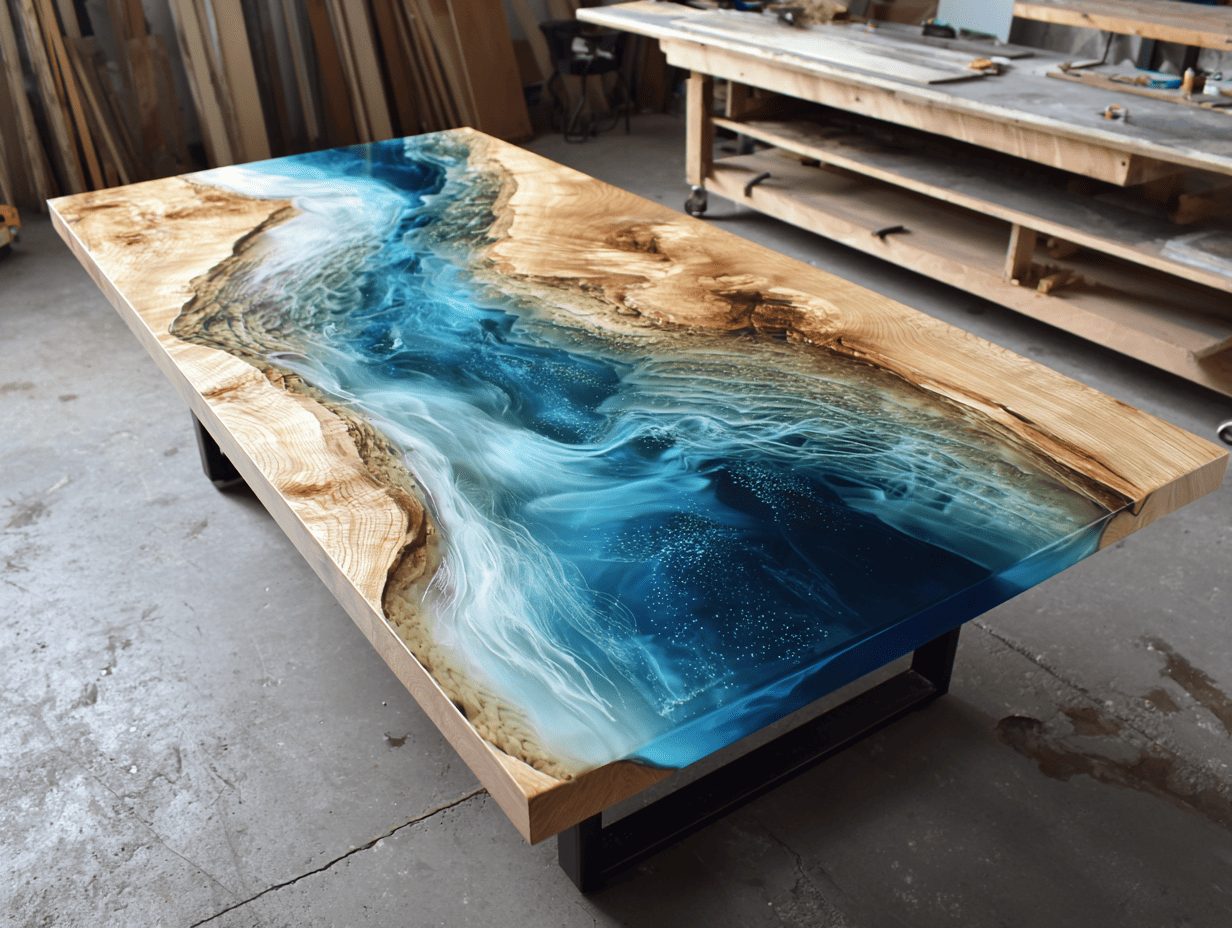
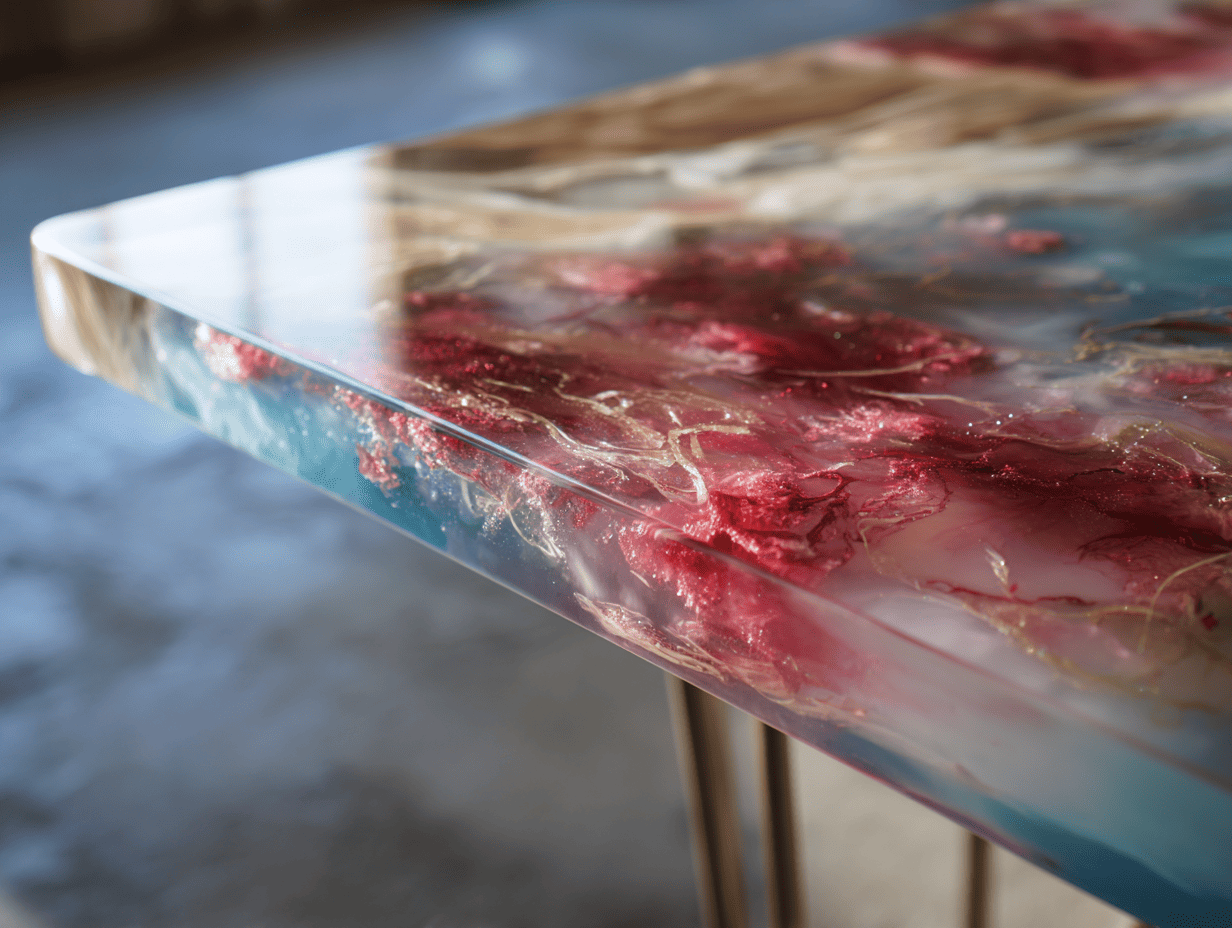
Epoxy resin tables have become extremely popular in recent years thanks to their unique appearance and glossy finish. Epoxy resin “river tables” refer to a specific technique used to create river-like patterns flowing through the tabletop. The striking contrast between wood and resin creates a stunning visual effect, giving these tables a strong artistic presence. Discover our tips for creating epoxy resin river tables.
Choosing and preparing the wood
The first step in creating your own epoxy resin river table is selecting and preparing the pieces of wood for the tabletop. You can use any type of wood depending on your preferences.
Make sure the wood is dry and as flat as possible. Once selected, use a wood chisel to remove the bark, then sand the surface to remove any loose material. Wipe or vacuum away dirt and dust thoroughly. This preparation allows the epoxy resin to bond properly to the solid wood, ensuring the finished table is mechanically strong. You may also choose to have this preparation done by your wood supplier.
Also remember to consider the placement of the table legs, which will be installed once the table has fully cured.
Working conditions
It is essential that the workshop environment is dry and ideally maintained at a temperature of around 20°C. It is strongly discouraged to carry out this project in cold conditions (below 15°C), overly hot conditions (above 25°C), or in a humid environment. These factors can negatively affect both the mechanical properties and the appearance of the resin. The workspace must also be free of dust.
In addition, it is vital to use appropriate personal protective equipment, such as gloves, long sleeves, and a mask, to work safely. Please refer to the product safety data sheets for further information.

Preparing the mould (formwork)
Prepare the mould to allow for resin pouring and curing. The formwork must create a completely watertight container.
For the base of the mould, you have several options: a chipboard panel or a polypropylene sheet larger than the final table dimensions. Place the wood slabs inside the mould. Then cut side barriers higher than the intended pour thickness to form a container around the wood.
Ensure the mould is watertight by applying silicone sealant to prevent any resin leakage during pouring. A hot glue gun can also be used to seal the joints.
Use clamps to secure the wood pieces firmly to the base of the mould. This prevents resin from seeping underneath the wood or causing it to float.
To make demoulding easier, apply a suitable release wax to the base and side barriers. Another option is to use adhesive tape coated with release wax. Note that demoulding is easier with polypropylene formwork, as resin does not adhere to it.
Before carrying out the main pour, mix a small quantity of resin and pour a thin test layer to check for leaks. Once this layer has cured, the underside of the wood will be sealed, reducing air bubble formation during the main pour.

Preparing the resin mixture
Calculate or estimate the total volume of resin required based on the table dimensions and desired thickness. Always prepare slightly more resin than calculated to avoid shortages.
If using a scale
Place the bucket on the scale and tare it. Pour in the calculated amount of resin, then add the hardener. Be as precise as possible—ideally to the nearest gram. The resin-to-hardener weight ratios are specified on the product datasheets.
For example, for a 500 g mixture with a ratio of 100:29, pour:
-
387.6 g of resin (500 / 1.29)
-
112.4 g of hardener (500 − 387.6)
If working by volume
The required ratios are specified on the product. For example, with a 2:1 ratio, add two parts resin to one part hardener.

If your calculations indicate that more hardener than resin is required, an error has occurred—there should never be more hardener than resin.
Mix both components thoroughly, scraping the sides and bottom of the container. This step is essential: mix for several minutes until the blend is completely homogeneous. Once mixed, pour the resin into a second container and mix again to ensure no unmixed resin remains.
Mix slowly to avoid trapping air bubbles in the resin.
During mixing, you can add epoxy colorants according to your preferences. Liquid dyes (similar to syrup) tint the resin, while pigments make it opaque.
During mixing, air bubbles of various sizes will appear. Remove them by degassing, either by vacuum or by gently heating the surface with a heat gun or torch. Heat only lightly and superficially to avoid thermal damage to the resin.
Pouring the resin
Once the epoxy resin has been degassed, pour it slowly into the mould. Use a spatula to distribute the resin evenly across the entire surface.
If your river table requires, for example, 40 kg of resin, it is strongly recommended not to prepare all the resin in a single container unless you have suitable equipment. Doing so can cause serious issues. Instead, pour in multiple batches—for example, eight containers of 5 kg each.
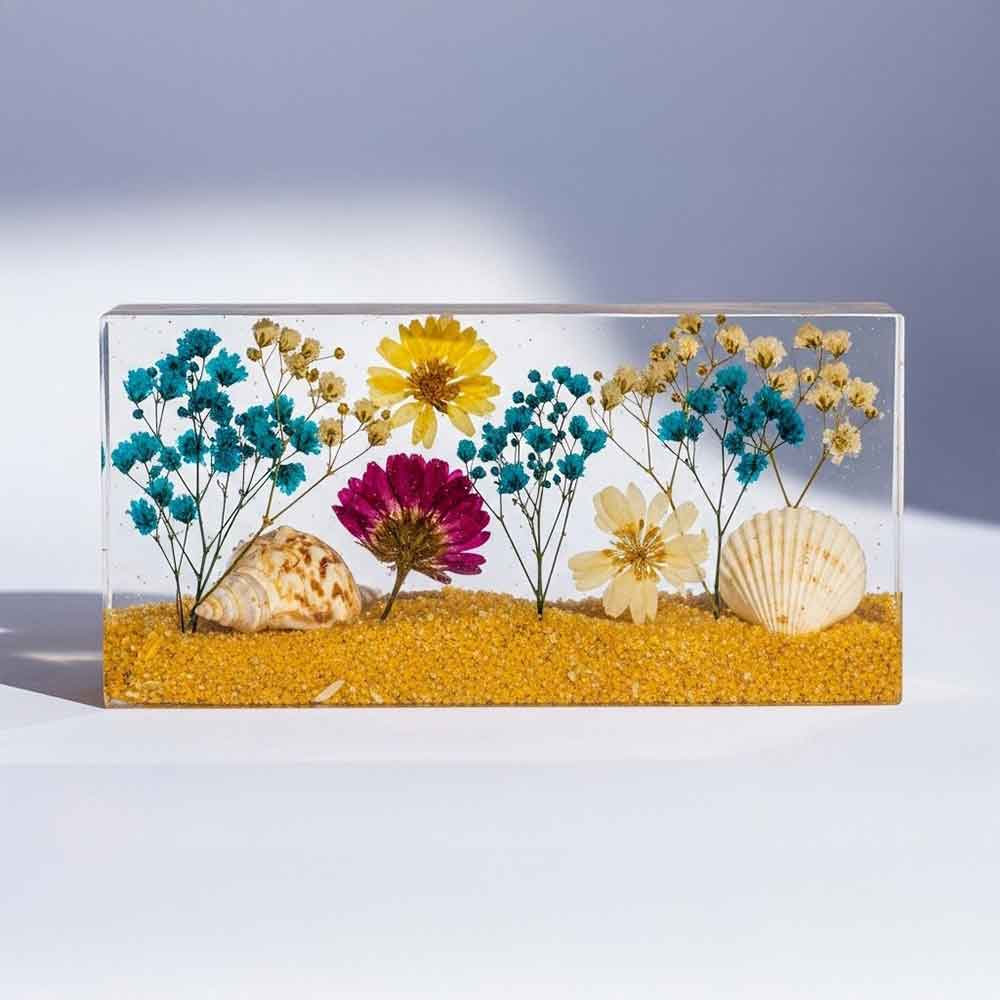
During the pour, you may include decorative objects or pearlescent effects as desired. Be sure to do this before the resin begins to gel, respecting the gel time indicated in the technical datasheet.

Allow the epoxy resin to cure according to the instructions provided in the technical documentation. Curing times vary depending on temperature and the volume of resin used.
Ensure that the temperature remains stable throughout the curing process.
Demoulding and sanding
Once the resin has fully cured, carefully remove the formwork. Use a file or sandpaper to remove any excess resin or burrs along the edges.
Proceed with final sanding to achieve a smooth tabletop surface. Use sandpaper with progressively finer grits. Start with a coarse grit and gradually move to finer grits to obtain a perfect finish. At each stage, ensure that all scratches from the previous grit are completely removed before moving on. If this step is not done properly, fine scratches will appear during final polishing, requiring you to repeat the sanding process.
Finally, apply a protective varnish or oil to the entire table to protect it and give it a glossy, refined appearance.
Conclusion
Creating an epoxy resin river table may seem intimidating at first, but with the right guidance and a bit of practice, you can create a unique work of art that will attract all eyes. Let your creativity flow and do not hesitate to experiment with different materials and techniques to create a table that reflects your personal style. With patience and determination, you will be rewarded with a stunning piece that will undoubtedly become the focal point of your living space.
Would you like to create your own epoxy resin river tables but still have questions about which products to use or how much resin is required? Do not hesitate to contact our team—we will be delighted to help.