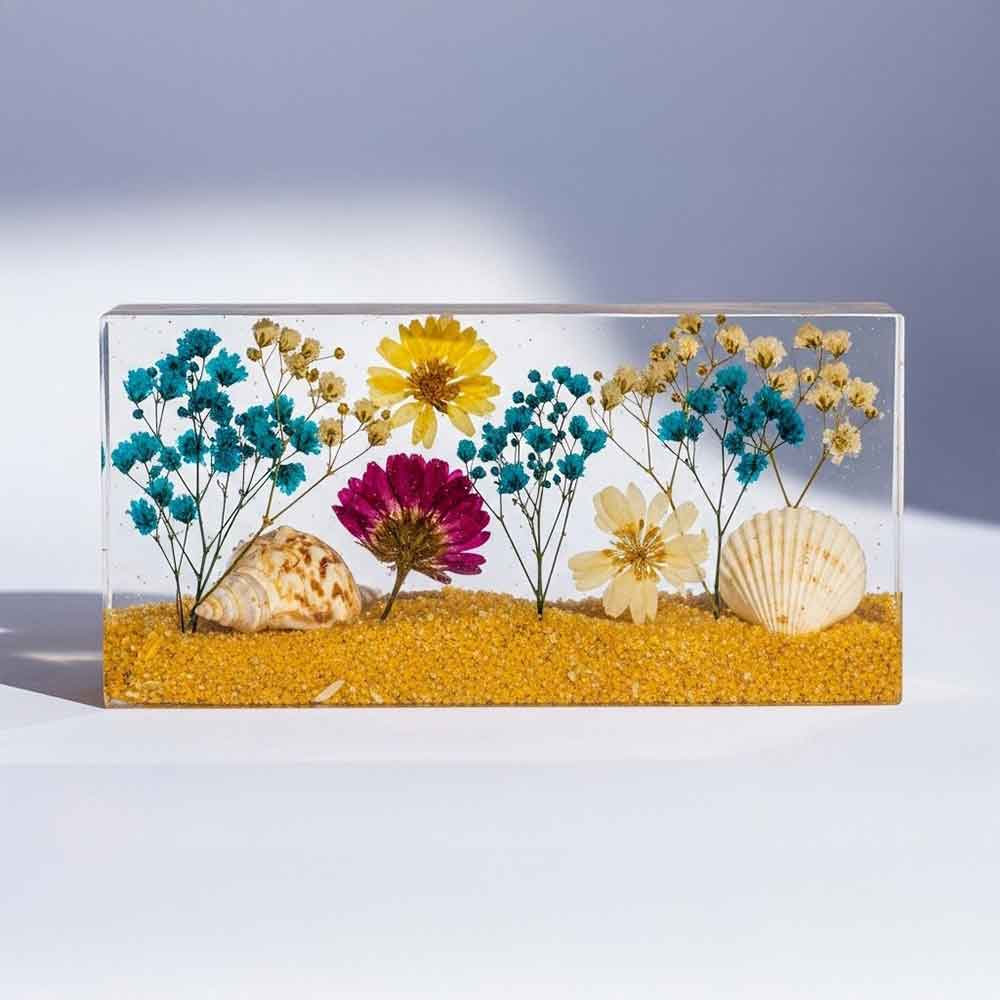
Epoxy resin is used in many fields, including decoration. While epoxy resin inclusions are increasingly popular and enjoy growing success in decoration and in the customization of objects or furniture, it’s important to know that creating them is more delicate than it often appears in the many videos you can find on YouTube. Before diving headfirst into such a project, it is essential to understand certain prerequisites and keep a few precautions in mind. In this article, we walk you through everything you need to know about creating an epoxy resin inclusion.
Which type of epoxy resin should you choose for an inclusion?
To successfully create an inclusion, it is important not to choose just any epoxy resin. There are different resin qualities on the market, and some are more suitable for inclusions than others.
While epoxy resins are known for their high strength, they do have one weakness: UV exposure. Sunlight can cause an undesirable reaction that gives the resin an unattractive yellow tint. To avoid this phenomenon—which could ruin the final look of your inclusion—it is essential to choose a high-quality, latest-generation epoxy resin and avoid low-cost resins sold on general consumer websites. These higher-end products contain additional additives that improve UV resistance and help maintain transparency.
Depending on the nature of your project, it may also be wise to choose a solvent-free epoxy resin. This type of product offers greater versatility, as it can be used on all surfaces, including the most delicate ones.
How to proceed step by step for a successful inclusion
A successful inclusion requires strict adherence to certain steps and the use of appropriate equipment. Here’s what you need to know.
What equipment do I need for an epoxy resin inclusion?
Before starting your inclusion, make sure you have all the necessary materials ready. You will need an epoxy resin kit with its hardener, a silicone mold, a container dedicated to mixing the two components, a spatula for mixing, several sheets of sandpaper with different grit sizes, and polishing compound for the final finishing stage.
What are the steps to successfully create an epoxy resin inclusion?
Got everything ready? It’s time to get into the core steps required to create a successful inclusion.
First, take your resin kit and hardener and mix them together. This step is crucial, as the quality of your final piece depends on it. Carefully follow the manufacturer’s recommended ratios and make sure the mixture is perfectly homogeneous. Finish this step by applying a thin layer of release agent, which will make demolding easier later on.
Next, pour your homogeneous resin–hardener mixture into the inclusion mold in a thick layer, but do not exceed half of the mold’s height. Allow the resin to begin curing.
Once the resin reaches a gel-like consistency, you can take the object or objects to be embedded and place them flat on the surface.
Prepare another batch of resin and hardener, mix until homogeneous, wait a few minutes, then pour this new mixture directly over the object until it is completely covered. Continue until you reach the top of the mold. For a clean result, make sure no air bubbles form.
After complete curing and full hardening of the resin, the next step is demolding. Once your inclusion is removed from the mold, you can move on to finishing by sanding with sandpaper—starting with a coarse grit and gradually moving to a finer one. To add shine, finish by applying polishing compound.